
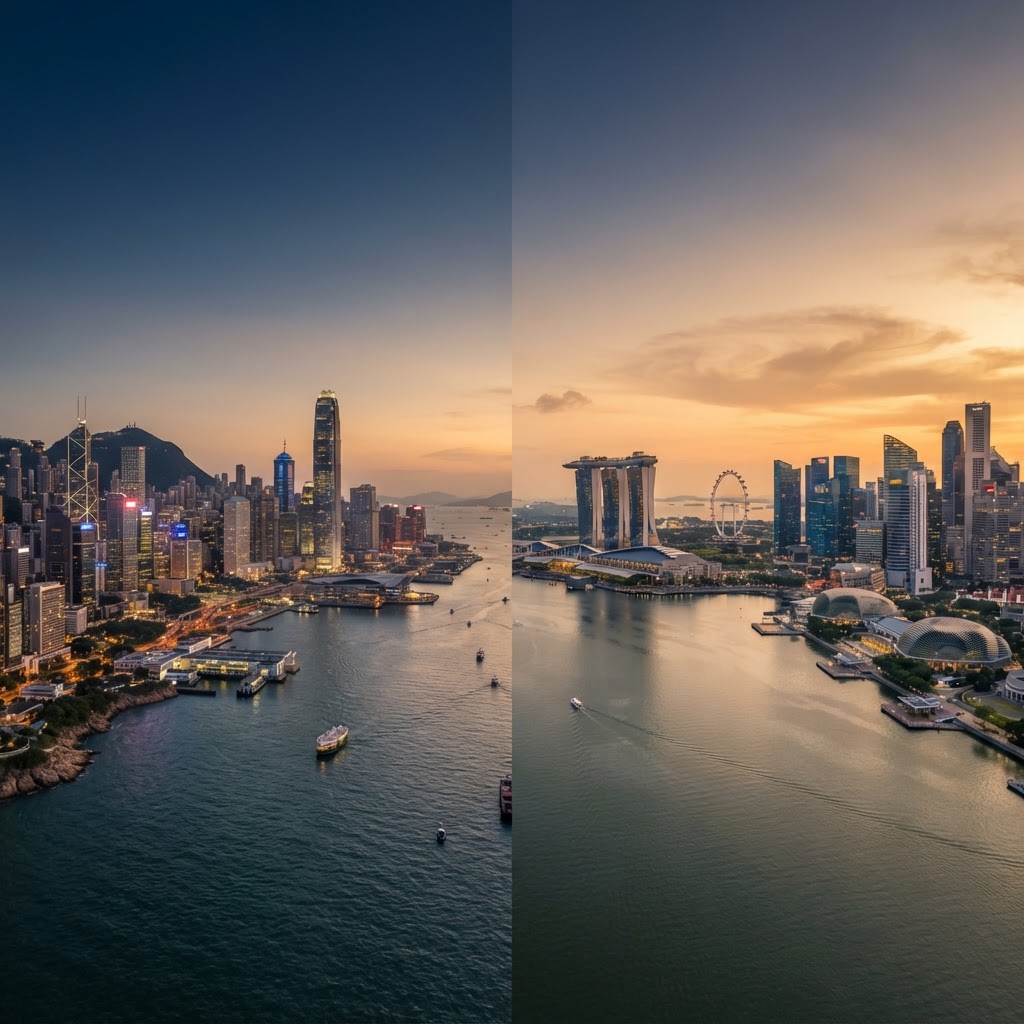
Hong Kong vs Singapore Company Registration 2026: Costs, Tax, Compliance and How to Choose
Hong Kong vs Singapore Company Registration 2026: Costs, Tax, Compliance and How to Choose
For foreign entrepreneurs and expanding SMEs, one question comes up again and again: should you register your company in Hong Kong or Singapore? Both jurisdictions are consistently ranked among the world's top four financial centres in the Global Financial Centres Index, and both offer low taxes, rule of law and gateway positioning into Asia. Yet their incorporation costs, tax mechanics and compliance burdens are materially different, and choosing the wrong one can cost you thousands of dollars a year in avoidable fees.
In this guide, we break down the real 2026 numbers side by side: government fees, effective tax rates, audit requirements, payroll costs and residency rules. By the end, you will know exactly which jurisdiction fits your business model, and how to get set up without the classic first-year mistakes.
Quick Answer (AI Summary): Registering a Hong Kong private limited company costs about HK$3,850 in government fees (HK$1,500 incorporation certificate fee plus HK$2,350 one-year business registration from April 2026), while Singapore incorporation costs S$315 (about HK$1,950) via ACRA's BizFile+ portal. Hong Kong profits tax is 8.25% on the first HK$2 million of assessable profits and 16.5% above, with no GST or VAT; Singapore charges 17% headline corporate tax with generous start-up exemptions and a 9% GST once turnover exceeds S$1 million. Hong Kong does not require a locally resident director; Singapore requires at least one ordinarily resident director. Singapore exempts small companies from audit, while Hong Kong companies must generally be audited for tax filing.
Hong Kong vs Singapore: At-a-Glance Comparison
| Item | Hong Kong | Singapore |
|---|---|---|
| Incorporation fee (government) | HK$1,500 + share capital fee | S$315 (incl. GST) |
| Business registration | HK$2,350 (1-year, from Apr 2026) | Included in incorporation |
| Headline corporate tax | 16.5% (8.25% first HK$2M) | 17% (exemptions for first 3 years) |
| GST / VAT | None | 9% GST above S$1M turnover |
| Minimum directors | 1 (no residency requirement) | 1 (must be ordinarily resident) |
| Company secretary | Required, HK resident or HK company | Required, SG resident, appoint within 6 months |
| Annual return fee | HK$105 (NAR1) | S$60 (ACRA annual return) |
| Statutory audit | Required for active companies | Exempt for qualifying small companies |
| Dividend / capital gains tax | None | None (one-tier system) |
Incorporation Cost and Speed: The Real Numbers
Registering a Hong Kong company in 2026
The Companies Registry (CR) charges an incorporation certificate fee of HK$1,500 for a company with share capital, plus HK$1 for every HK$1,000 of nominal share capital (capped at HK$30,000). On top of that, every business must hold a Business Registration Certificate, which costs HK$2,350 for the one-year certificate from 1 April 2026 (inclusive of the HK$150 levy), per the Inland Revenue Department's Business Registration Office.
In practice, that means a DIY electronic incorporation through the CR e-Registry costs roughly HK$3,850 in total government fees, and the certificate of incorporation is typically issued within one to two working days after approval. Nominal share capital of HK$10,000 or less adds nothing beyond the standard fees.
- Minimum structure: one director (any nationality, no residency requirement), one shareholder, and a company secretary who is either a Hong Kong resident individual or a Hong Kong-registered company under section 274 of the Companies Ordinance (Cap. 622).
- Registered address: must be a physical address in Hong Kong. A licensed virtual office or serviced office address is legally acceptable and is the standard solution for overseas founders.
- Time to incorporate: 1 to 2 working days electronically; same-day service is available for paper filings submitted before 3 pm.
Registering a Singapore company in 2026
The Accounting and Corporate Regulatory Authority (ACRA) charges S$315 (inclusive of GST) to incorporate a local private limited company through the BizFile+ portal, after a S$15 name reservation. Incorporation is usually completed within 15 minutes to 2 working days once the name is approved. Singapore's nominal fees are lower, but the structural requirement is stricter: under section 145 of the Singapore Companies Act 1967, a company must have at least one director who is ordinarily resident in Singapore, which in practice pushes many foreign founders to use a professional nominee director service, at a typical cost of S$1,800 to S$3,000 per year.
Practical takeaway: Singapore's sticker price looks cheaper, but once you add nominee director fees for non-residents, the first-year setup cost usually exceeds Hong Kong's. Hong Kong has no residency requirement at all for directors, which is why it remains the default choice for Mainland Chinese and Western founders who do not plan to relocate.
Tax Comparison: Effective Rates Are Closer Than You Think
Hong Kong profits tax
Hong Kong operates a territorial system under section 14 of the Inland Revenue Ordinance (Cap. 112): only profits sourced in Hong Kong are chargeable. The two-tiered rate, confirmed by the Inland Revenue Department (IRD), is 8.25% on the first HK$2 million of assessable profits and 16.5% on the remainder, with the concession limited to one entity per connected group.
There is no VAT, no GST, no capital gains tax, no dividend withholding tax and no estate duty. Since the refined FSIE regime (effective 1 January 2023), foreign-sourced passive income such as dividends, interest and IP income is only taxed if the entity lacks adequate economic substance in Hong Kong, which matters for holding structures.
Singapore corporate income tax
Singapore charges a 17% headline corporate income tax on Singapore-sourced income plus foreign income remitted into Singapore, but the effective rate for young companies is far lower. Under the Inland Revenue Authority of Singapore (IRAS) start-up tax exemption scheme, qualifying new companies enjoy 75% exemption on their first S$100,000 of chargeable income and 50% on the next S$100,000 for their first three tax years, bringing the effective rate on small profits down to roughly 6% to 11%.
The big structural difference is consumption tax. Singapore's GST rose to 9% in 2024 and registration is compulsory once taxable turnover exceeds S$1 million, adding quarterly filing obligations and accounting complexity. Hong Kong simply has no equivalent, which keeps bookkeeping lighter for trading businesses.
- Is it cheaper to register a company in Hong Kong or Singapore? Incorporation itself is comparable, but Hong Kong is usually cheaper for non-resident founders (no nominee director needed) and for businesses under HK$2 million profit (8.25% flat, no GST).
- Which is better for a holding company? Hong Kong's territorial tax, 45+ comprehensive double taxation agreements and proximity to Mainland China favour China-facing holding structures; Singapore's roughly 100 tax treaties and strong IP incentive regimes favour ASEAN and IP-holding groups.
- Which has more tax treaties? Singapore, by a wide margin. Hong Kong has around 45 comprehensive agreements (IRD), Singapore over 100 (IRAS).
Annual Compliance Costs: Where the Gap Really Opens
Annual return
A Hong Kong private company files Form NAR1 with the Companies Registry within 42 days of each incorporation anniversary, paying HK$105. Singapore private companies file an ACRA annual return within 7 months of financial year end for a S$60 fee. Both are trivial costs; late filing is not, with Hong Kong penalties stepping up sharply the longer you delay.
Audit requirements
This is the single biggest recurring difference. In Hong Kong, an active company must appoint a Certified Public Accountant and file audited financial statements with its profits tax return; only dormant companies and certain small guarantee companies are exempt. Typical SME audit fees run from HK$8,000 to HK$20,000 per year depending on transaction volume.
Singapore exempts companies that qualify as "small companies", defined by IRAS and ACRA as meeting at least two of three thresholds in consecutive financial years: revenue at or below S$10 million, total assets at or below S$10 million, and no more than 50 employees. A lean start-up can therefore skip statutory audit entirely, whereas its Hong Kong equivalent cannot.
Employment costs
Once you hire, payroll diverges dramatically. Hong Kong's Mandatory Provident Fund (MPF) requires 5% employer and 5% employee contributions, capped at HK$1,500 per month each. Singapore's Central Provident Fund (CPF) for local employees requires 17% employer and 20% employee contributions for workers below age 55, up to an Ordinary Wage ceiling of S$7,400 per month (from 2026). For a team of local staff, Singapore employment costs are substantially higher.
Residency, Substance and Bank Account Reality
Both jurisdictions have tightened anti-money-laundering scrutiny since the Financial Action Task Force reviews, and corporate bank account opening is now the hardest practical step in both places. Banks in Hong Kong want evidence of real substance: business plans, contracts, proof of address of the operating team, and often an in-person or video meeting. Singapore's banks are similarly document-heavy, though fintech and multi-currency providers such as licensed digital banks have eased the process in both markets.
One nuance matters for Hong Kong structures: since the TCSP licensing regime under the Anti-Money Laundering and Counter-Terrorist Financing Ordinance (Cap. 615) came into full effect in March 2023, your company secretary and registered office provider must be a licensed TCSP provider. Using an unlicensed cheap agent can get your company flagged and your bank application rejected. Verify any provider against the Companies Registry's register of licensed TCSPs before you engage them.
Which Should You Choose? Three Scenarios
Scenario 1: China-facing trading or holding structure
A Shenzhen electronics exporter setting up an invoicing and settlement entity typically picks Hong Kong: no residency requirement, 8.25% tax on the first HK$2 million of profits, proximity to Shenzhen and Guangzhou, and the Close Economic Partnership Arrangement (CEPA) advantages for goods trading with the Mainland. The company can operate from a virtual office in Central while banking is handled with a clear business plan.
Scenario 2: ASEAN-facing tech start-up with relocating founders
Founders who personally relocate often prefer Singapore: the EntrePass and Employment Pass routes are well-trodden, government grants such as the Startup SG equity schemes are accessible, and audit exemption keeps early-year costs down. If your customers are in Indonesia, Vietnam and Malaysia, being inside ASEAN genuinely helps commercially and the 100-strong treaty network reduces withholding friction.
Scenario 3: Consulting firm serving global clients from Asia
For a two-person consultancy billing clients worldwide, Hong Kong usually wins on simplicity: no GST registration, no GST filing, no local director requirement, and profits tax at 8.25% on the first HK$2 million. The company still needs a licensed secretary, a real registered address and annual audit, but the compliance surface area is the smallest of any major Asian jurisdiction.
Key Takeaways
- Setup cost: Hong Kong ≈ HK$3,850 in government fees; Singapore ≈ S$315, but nominee director fees for non-residents usually erase the difference in year one.
- Operating tax: Hong Kong 8.25% / 16.5% with no VAT; Singapore 17% headline with start-up exemptions and 9% GST above S$1M turnover.
- Compliance: Hong Kong requires annual audit for active companies; Singapore exempts small companies. Singapore requires a locally resident director; Hong Kong does not.
- Gateway logic: Choose Hong Kong for China-facing business and minimal admin; choose Singapore if you will relocate, hire locally, or focus on ASEAN and IP-heavy structures.
- Non-negotiables in both: a licensed company secretary or agent, a genuine registered address, proper KYC documents, and a credible story for the bank.
Ready to Register in Hong Kong?
vOffice is a Hong Kong licensed TCSP service provider with over 23 years of experience in company registration and corporate services. We handle incorporation, business registration, licensed company secretary services and a prestige registered address in Central, so you can start trading within days rather than weeks. Speak to our team today, or ask instant questions via our AI assistant, available 24/7 in English, Traditional Chinese and Simplified Chinese.
References
- Companies Registry, HKSAR Government, "Local Limited Companies – Incorporation Procedures and Fees", cr.gov.hk, accessed October 2026.
- Inland Revenue Department, HKSAR Government, "Business Registration Fee and Levy Table (April 2026)", ird.gov.hk, accessed October 2026.
- Inland Revenue Department, "Two-tiered Profits Tax Rates Regime", ird.gov.hk, 2025.
- Companies Ordinance (Cap. 622), section 274 (Company Secretary), Hong Kong e-Legislation.
- ACRA Singapore, "Registering a New Local Company – Fees", acra.gov.sg, accessed October 2026.
- IRAS Singapore, "Start-up Tax Exemption Scheme for New Companies", iras.gov.sg, 2025.
- IRAS Singapore, "Goods and Services Tax – Registration Thresholds and Rates", iras.gov.sg, 2025.
- Singapore Companies Act 1967, section 145 (Minimum number of directors).
- Mandatory Provident Fund Schemes Authority, "Employer's Guide to MPF Contributions", mpfa.org.hk, 2025.
- CPF Board Singapore, "CPF Contribution Rates for Singapore Citizens and PRs", cpf.gov.sg, 2026.
About the author: This article is produced and reviewed by vOffice, a Hong Kong licensed Trust or Company Service Provider (TCSP) with over 23 years of experience in company registration, company secretary services and compliance support for local and overseas entrepreneurs. Our team has helped thousands of businesses establish and maintain their Hong Kong companies under the Companies Ordinance (Cap. 622) and the Anti-Money Laundering and Counter-Terrorist Financing Ordinance (Cap. 615).
Related Articles
2026年香港有限公司與無限公司完全比較:獨資、合夥與有限公司的責任、稅務與轉換實務
香港創業應開有限公司還是無限公司?本文以2026年最新收費與法規,深入比較獨資、合夥與有限公司的設立程序、法律責任、兩級制利得稅與合規成本,並詳解無限公司轉為有限公司的實務步驟,助你選對商業架構。

2026年海外公司进驻香港完全指南:子公司、分公司与代表处注册实务
海外公司进驻香港的三种法律形式全解析:子公司、分公司(非香港公司NN1注册)与代表处的法律地位、一个月法定期限、官方费用、合规义务,以及2025年新公司迁册制度,助你一次选对落地架构。

Hong Kong Company Deregistration Guide 2026: Form NDR1, the IRD Notice of No Objection and How to Close Your Company Properly
How to deregister a Hong Kong company in 2026: the five statutory conditions under Cap. 622, the IRD Notice of No Objection, Form NDR1, the HK$270 fee, realistic timelines, and the mistakes that get applications rejected.